
This article was developed in partnership with George Steimer. George was a long-time product manager for Technology Services Group as well as Alfresco/Hyland, and is now a founder of Docuvela offering consulting and software development services.
A key challenge for technology consulting firms is how and when to invest in Research and Development (R&D). If done correctly, R&D allows consulting firms to better advise clients while staying ahead of their competitors. In a best-case scenario, a long-term customer will add new technology to a project, and the consulting firm will not only learn the technology, but also learn how to apply the technology to the customer’s business opportunity. Unfortunately, customer-driven R&D is difficult to sell and difficult to schedule on a timely basis such that the consulting firm has enough of a jump-start on their competitors. This post will discuss how Technology Services Group (TSG) addressed internal Research and Development issues and cost with a “2 inch deep” methodology.
Why Research and Development?
Investing in Research and Development provides a variety of benefits for technology consulting firms. R&D allows the technology consulting firm to:
- Understand technologies before recommending them to clients, resulting in better sales and estimating capabilities
- Differentiate from competitors in attracting and retaining customers
- Attract and retain consultants that want to work with new technologies
- Provide productive and interesting non-billable work for consultants at all levels of the consulting firm (see related article Culture Quick Fix – Embracing the Bench)
The difficult part for management is determining who to and how much effort to invest in R&D activities, particularly when R&D might pull away from billable client work or other commitments. Even though my company, TSG, followed a philosophy that billable work would always be prioritized over Research and Development, we would work to balance specific R&D budgets and timelines based on both the perceived urgency of the R&D effort, competing client engagements, and the availability of staff.
Betting and R&D
For consulting firms, non-billable activities can represent “bets” that could be turned into either billable work or other revenue-generating channels, including software sales. The odds on some non-billable bets are very safe. An example of a safe bet could be investing in training of consultants where the most likely result is better quality and billings in the future. Research and Development bets, however, represent the riskiest bets as the effort might never turn into billable work.
“2 Inch Deep” Research and Development focuses on placing small bets (with small budgets) and getting feedback before placing larger bets with larger budgets. This approach in no way limits the eventual development of large efforts, rather it focuses on feedback to determine where that effort should go throughout the process. Instead of placing a large bet with a “damn the torpedoes” approach, which would potentially risk the long-term stability of the firm, small bets keep the focus on the current efforts and mitigate the risk with feedback from the small bets.
Goals Surrounding “2 Inch Deep” Research and Development
For our research and development activities at TSG, the “2 Inch Deep” methodology arose out of our specific needs as a technology consulting firm regarding new technology. Goals of our improved Research and Development included:
- Develop a practical understanding of the technology to better advise clients with recommending for or against the technology
- Estimating the impact of the technology on our work
- Develop a real demonstration that we could show clients and potential customers to prove our knowledge of the technology, while also getting feedback from the customer as to whether the technology was relevant to their business
- Apply the technology to a specific business scenario to prove that we had experience and understood the technology. We would often require that the R&D be documented in a post on our blog site
“2 Inch Deep” focused on our consultants developing a basic understanding of the technology to both reduce the effort and timeframe. By publishing the results in a blog, the internal effort had a defined published deliverable rather than just the knowledge of the consultants that worked on the effort.
What’s Next after “2 Inch Deep” Research and Development
After the development effort is complete:
- A client or clients would be interested, and we would either sell work around the technology to the clients or decide to continue to fund the effort ourselves
- If initial client reaction to the blog post and effort was weak, TSG would move on to different R&D efforts until their reaction improved
By focusing on paying customers and potential customer feedback, our team could avoid some of the weaknesses faced by most software product development, including:
- Engineering-led product development – Engineers can often take feedback from customers or the market to determine where to focus research and development. Unfortunately, feedback is often only opinions from vocal customers, which can lead engineering down expensive and unsuccessful efforts. With the “2 Inch Deep” approach, TSG was able to get feedback from clients that was not only broader and deeper but also had the added input of how much the client would pay for the development effort. If clients won’t pay for the development, TSG would gain a better understanding of a client’s needs instead of the client simply vocalizing their thoughts to engineering. Engineers can also be jaded by the market to pick development efforts that interest them or build their resumes rather than satisfy customer needs. With the “2 Inch Deep” approach, Engineers satisfy the need to explore and broaden their (and the company’s) knowledge, without spending the time and money on efforts that will not be embraced by paying customers.
- Sales-led product development – Sales can often take feedback from customers or potential customers on product improvements. Feedback could be after a sale is unsuccessful, or can be in response to customer complaints after a sale. Sales feedback from customers is often more telling than engineering feedback. While both types of feedback can be biased, sales feedback has a cost and opportunity focus that engineering focus typically lacks. There is usually a back-and-forth of sales pushing that “we could sell more product if engineering listen to us” and engineering responding with “sales is always pushing for different things based on their own bias of what would sell without understanding the technology or customer needs.” Another concern arises where sales-led product development is too short-term focused on “this quarter” or “this customer,” as sales is very commission- and quarterly-motivated.
“2 Inch Deep” focuses on getting feedback from customers with input from both sales and engineering, and without either driving the decision on where to place the R&D bets.
How TSG did “2 Inch Deep” Research and Development
TSG implemented both “daily huddles” and quarterly manager meetings. In our quarterly meetings, we would dedicate an hour or so to talking about what R&D activities we should pursue for the current quarter. In a “team engagement” approach, we would encourage all managers to bring their ideas to the meeting. Ideas were placed on a whiteboard with a vertical placement based on how much effort the R&D would require (low cost/easy items were at the bottom, high cost/difficult at the top) and a horizontal placement based on our thoughts on whether a client would pay for the effort (client would not pay on the left with client would pay all the way to the right).
All ideas would be placed on the board and the team would debate about the specific placement with a push to always reduce the cost and effort. Once the board was defined, each team member would get three “votes” on which efforts we should add to our quarterly goals.
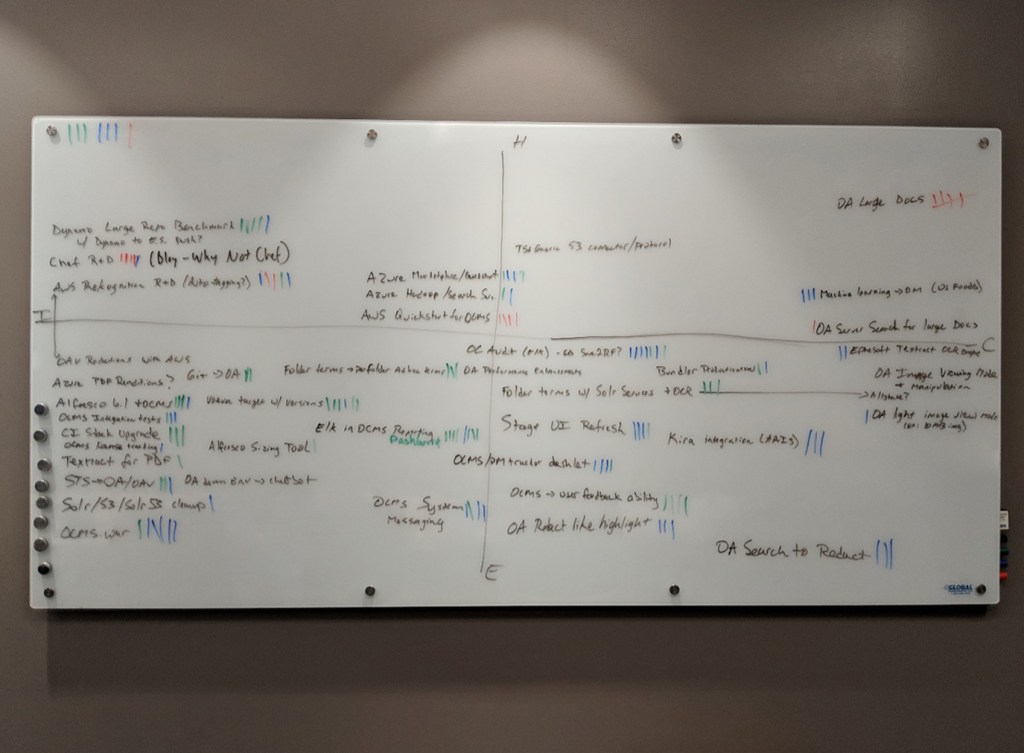
(Example of whiteboard from one TSG quarterly meeting in 2020)
With a limited budget in mind, different managers would take responsibility for each R&D activity that was chosen and report back to the team in the different daily huddle meetings. R&D efforts would also be a big component of our annual client briefing, where we would present our findings to our gathering of customers for consideration in their efforts.
By allowing for open brainstorming and voting, the team was eventually able to add most things from the board to the quarterly goals. As an example, in one of the quarterly meetings during the Covid lockdown, our team brainstormed on how remote workers annotating documents might want to quickly kick off meetings from within the document. The light integration was easy for the product manager to both develop and blog about. The Microsoft teams integration followed a post in regards to Zoom integration. While we didn’t have any specific customer asking for the integration, the “2 Inch Deep” R&D was fairly simple and quickly became a feature of the Enterprise Viewer product. You can see the blog and demo here: Microsoft Teams integration and the Alfresco Enterprise Viewer for Document Review
What “2 Inch Deep” R&D Is Being Done Today?
Today, Docuvela is continuing TSG’s lead in making R&D bets using the “2 Inch Deep” methodology. There are many exciting new technologies in the content services space, not the least of which is Generative AI models such as ChatGPT. Docuvela is currently focusing R&D efforts toward how ChatGPT and other generative AIs can be integrated with content services platforms such as Alfresco, Nuxeo, and Documentum. Generative AI could power many new customer features such as document summarization, audit and access summarization, AI-driven repository search, and AI chatbots that are “experts” in an organization’s key documentation. You can follow Docuvela on LinkedIn, X/Twitter, or visit the Docuvela blog to learn more about Docuvela’s R&D efforts.
Conclusion
Research and Development for technology consulting firms can allow a company to differentiate from competitors, expand customer services, as well as motivate and retain consulting staff. Balancing the time and cost of specific efforts with customer and budgetary constraints requires a focus on small efforts alongside team and customer feedback to determine next steps. TSG was able to develop a “2 Inch Deep” approach through quarterly meetings, daily huddles, and customer briefings that improved our breadth of research and development activities while keeping tightly focused on budget and timeline constraints and it great to see that continue with Docuvela.
 Founder in Eleven
Leave a comment